
VLAD TEPES
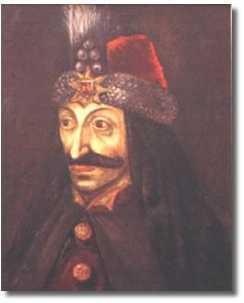
Dracula or Vlad the Impaler was the son of Vlad Dracul (1390-1447) and grandson of Mircea the Old (1386-1418). Vlad Dracul was dubbed a knight of the Dragon Order by the Hungarian king. All the members of the order had a dragon on their coat of arms, and that is what brought him the nickname of Dracul (the Devil). Vlad the Impaler used to sign himself Draculea or Draculya - the Devil's son -, a name which was distorted into Dracula.
More than anything else, Vlad III TEPES is known for his exceeding cruelty. Impalement was Tepes's preferred method of torture and execution. His method of torture - a horse attached to each of the victim's legs as a sharpened stake was gradually forced into the body. The end of the stake was usually oiled, and care was taken that the stake not be too sharp; else the victim might die too rapidly from shock. Normally the stake was inserted into the body through the anus and was often forced through the body until it emerged from the mouth. However, there were many instances where victims were impaled through other bodily orifices or through the abdomen or chest. Infants were sometimes impaled on the stake forced through their mother's chests. The records indicate that victims were sometimes impaled so that they hung upside down on the stake.
As expected, death by impalement was slow and painful. Victims sometimes endured for hours or days. Vlad often had the stakes arranged in various geometric patterns. The most common pattern was a ring of concentric circles in the outskirts of a city that constituted his target. The height of the spear indicated the rank of the victim. The corpses were often left decaying for months.
Thousands were often impaled at a single time. 10,000 were impaled in the Transylvanian city of Sibiu (where Vlad the Impaler had once lived) in 1460. The previous year, on Saint Bartholomew's Day (in August), Vlad the Impaler had 30,000 of the merchants and officials of the Transylvanian city of Brasov that were breaking his authority impaled. One of the most famous woodcuts of the period shows Vlad the Impaler feasting amongst a forest of stakes and their grisly burdens outside Brasov, while a nearby executioner cuts apart other victims.
Impalement was Vlad the Impaler's favourite but by no means his only method of torture. The list of tortures employed by the prince is extensive: nails in heads, cutting off of limbs, blinding, strangulation, burning, cutting off of noses and ears, mutilation of sexual organs (especially in the case of women), scalping, skinning, exposure to the elements or to animals, and boiling alive.
Vlad Tepes committed even more impalements and other tortures against invading forces, namely Ottomans. It was once reported that an invading Ottoman army turned back in fright when it encountered thousands of rotting corpses impaled on the banks of the Danube. In 1462 Mehmed II, the conqueror of Constantinople, a man not noted for his squeamishness, returned to Constantinople after being sickened by the sight of 20,000 impaled corpses outside of Vlad's capital of Targoviste. Many of the victims were Turkish prisoners of war Vlad had previously captured during the Turkish invasion. The total Turkish casualty toll in this battle reached over 40,000. The warrior sultan turned command of the campaign against Vlad over to subordinates and returned to Istanbul, even though his army had initially tripled Vlad's in size and was better equipped.
Vlad the Impaler began his reign of terror almost as soon as he came to power. His first significant act of cruelty may have been motivated by a desire of revenge as well as a need to solidify his power. Early in his reign he gave a feast for his boyars and their families to celebrate Easter. Vlad was well aware that many of these same nobles were part of the conspiracy that led to his father's assassination and the burying alive of his elder brother, Mircea. Many had also played a role in the overthrow of numerous Wallachian princes. During the feast Vlad asked his noble guests how many princes had ruled during their life times. All of the nobles present had outlived several princes. One answered that at least thirty princes had held the throne during his life. None had seen less than seven reigns. Vlad immediately had all the assembled nobles arrested. The older boyars and their families were impaled on the spot. The younger and healthier nobles and their families were marched north from Targoviste to the ruins of Poienari Castle in the mountains above the Arges River. Vlad the Impaler was determined to rebuild this ancient fortress as his own stronghold and refuge. The enslaved boyars and their families were forced to labor for months rebuilding the old castle with materials from another nearby ruin. According to the reports, they labored until the clothes fell off their bodies and then were forced to continue working naked. Very few of the old gentry survived the ordeal of building Vlad's castle.
n 1476, Vlad was killed. His body was buried in the church of the Snagov Monastery, on an island near Bucharest. His body lies in front of the altar. In 1935, a richly dressed but beheaded corpse was exhumed at Snagov, a fate known to have overtaken Dracula, whose head was supposedly wrapped, perfumed and dispatched as a gift to the Turkish sultan.`

VLAD'S TOMB
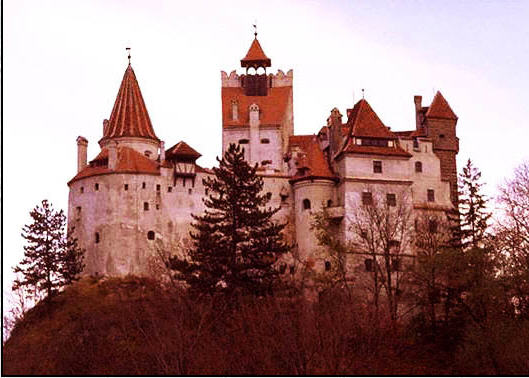
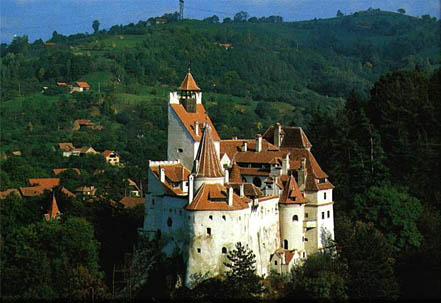
When people visit Transylvania, they want to visit Dracula's Castle. However, most visit Bran Castle not realizing that Vlad Tepes never lived there.
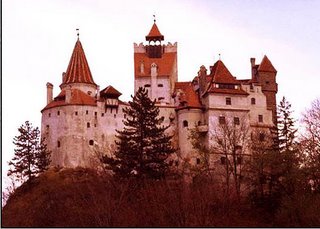
DRACULA'S CASTLE (BRAN CASTLE)


A TUNNEL IN BRAN CASTLE FOUND IN 1930
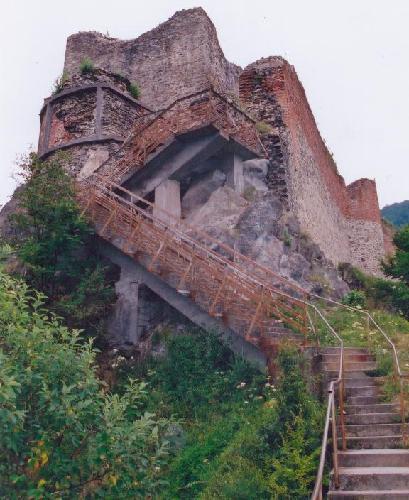
Dracula's real castle is Poenari castle. Built in 1457 A.D., Poenari castle sits on top of a hill overlooking the Arges river passage. The castle was used for many years after Vlad's death in 1476, it eventually was abandoned again in the first half of the 16th century and was in ruins during the 17th century. Due to its size and location, the castle was very hard to seize, even by natural forces. However, in 1888, a landslide brought down a portion of the castle which crashed into the river far below. Nonetheless, the castle was slightly repaired and the walls and its towers still stand today.

THE REAL DRACULA'S CASTLE
For More Information on VLAD TEPES and his CASTLE'S CHECK OUT THE SITES BELOW
BOOTS AND ALL.COMWIKIPEDIA.COM VLADVLAD THE IMPALERTAGS
entertainmentHorror


 Atom Feed (xml)





 VICTIMS


